
Navigating your technical career pathway.

As someone who went through various levels of the technical roles and different careers that were available to me, I’ve come to know the distinct differences between all of the four major levels. In another post I’ll share the story of my career and how my interests and needs helped evolve my professional growth.
First, let’s start with the hierarchy of technical roles in BC. Keep in mind this is also reflective of the different governing bodies in Canada but depending on which province you’re in, there may be some small differences. For the most part, each governing body will have their equivalents in each Canadian province you may be located in.
In terms of technical roles, the hierarchy tree starts with skilled trades persons, then you have a technician, technologist, and finally the engineer which is at the top of the tree.
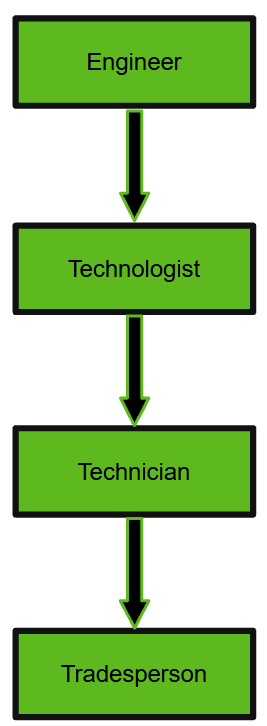
Tradespersons
These are the people who are doing the practical work to get things done. This could be a millright who is diagnosing hydraulics on a heavy equipment machine, this could be a mechanic who’s turning wrenches on a semi truck or this could be a carpenter nailing together studs to put up the framing of a house. In British Columbia, trades are regulated by SkilledTradesBC, formerly known as ITA (Industry Training Authority). Typically for most trades you need to progress through three or four different levels over the course of three to four years in order to attain your professional designation of a Journeyman(woman) Certificate. This ticket lets you practice within the province as an experienced tradesman. After the Journeyman there is an additional certification called the Red Seal which can be obtained. This allows for you to practice as a professional Journeyman across the entire country of Canada.
There are three ways to obtain your Journeyman and Red Seal certification:
- The first option is to register as an apprentice and have a sponsor employer. This involves working for the majority of the year and spending the remaining 2-3 months in a polytechnic institute such as Kwantlen or BCIT (British Columbia Institute of Technology). This cycle of working and schooling repeats over the course of three to four years depending on your trade of choice.
- The second option is to complete a foundations program which is a program that is anywhere from 7-9 months long and lets you enter the Apprentice “ladder” at the second level out of four (or third level out of three for some trades) instead of the first.
- The third option is to challenge the Red Seal and Journeyman ticket. This option is only for those who have recorded and verified work experience from past employers. Different provinces have different requirements but for BC you’ll need anywhere from 6800-7000 hours of work experience (trade dependent) and have to take two exams. One is the Red Seal multiple choice exam and the other is a practical exam where your hands-on skills are examined. As an example lets consider Welding. You will need 6930hrs of work experience, a pass on the Red Seal theory MC exam as well as a pass the practical exam. I’ll explain the practical exam details in another post.

Technician
As we move up higher one step to a Technician, things become a bit more technical while still retaining some of the practical hands-on side of the job. To become a Certified Technician as governed by the ASTTBC (Associated Science Technologists and Technicians of British Columbia), you must have completed a one-year education certificate along with two years of work experience and an Ethics exam. The typical job duties for this position will still involve some hands-on work but the nature of the work tends to be more sophisticated. Think of someone who is a junior technologist, where the nature of the work is similar to a technologist but there is likely to be more hands-on rather than in-office. Furthermore, the work may be of a higher degree of technicality as compared to a tradesperson often in close supervision by a technologist or engineer. This can include data collection, use of sophisticated processes, specialized equipment and be of a unique nature. This can include titles such as drafter, quality control tech, calibration tech, estimator, sales, etc.
Becoming a Technician is possible in various industries such as architecture, forestry, biosciences, materials, resources, systems, building, etc. Often, Technicians who progress to the later stages of their career can become technical experts for certain processes and procedures. Some Technicians may choose to take the required competency exam to become an Applied Science Technologist.
Certified Technician – Applied Science Technologists & Technicians of British Columbia

Technologist
Moving along to the technologist stage and things become more technical and less hands-on. These personnel are known as engineering technologists or applied science technologists (AScT). Technologist certification is governed by ASTTBC. To qualify for the AScT certification you must take a two-year engineering technologist diploma course, have two years of experience as a technologist with at least one year of supervised experience and complete an Ethics exam. Technologists are more heavily involved in the analysis and interpretation of scenarios and issues while still maintaining some sort of the hands-on aspect of technical work. In addition, after six years have passed as an AScT, you may apply for a Professional Technologist designation (P.Tech). Withing these six years at least two must be at a senior level and one year must be under a P.Eng. P.Tech designated technologists tend to have more supervisory capacities and responsibilities.
Some roles for a technologist include data collection and interpretation or others such as a building or structural inspector, welding inspector, drafting technologist, surveyor, telecontroller, lab technologist and many more. Technologists are required in nearly all technical and engineering related roles. This could be mechanical, electrical, chemical, civil, materials, biomedical, etc. Even in the case of an experienced Technologist, Engineers will still oversee or manage a team of technologists and are required for the final sign-off of a technologist’s work.
Applied Science Technologist – Applied Science Technologists & Technicians of British Columbia

Engineer
Engineers are at the top of the hierarchy chain in terms of technical roles. These personnel tend to have very little to no hands-on work in their job roles and are focused more on design and consultation, reviewing work and/or managing workflows. Accreditation is governed by the body of EGBC (Engineers and Geoscientists of British Columbia). To qualify as an engineer in BC you must take a four year program (bachelors degree) in an accredited program at which point you can apply to be an Engineer-in-Training. After four years of working at the EIT level under direct supervision of a P.Eng, you can then apply for a P.Eng designation. P.Eng’s are the ones who have the power to sign and stamp off on drawings, documents, designs etc. For better or for worse, this ability can also potentially make them legally responsible if that item or design fails, depending on what the item or design may be.
Out of country applicants are also able to transfer over their education and job experience form outside of the province but the process of accreditation becomes a bit more complicated. Often you will need to prove you have the required competencies as required by the engineering discipline you are choosing to be accredited in. This requires competency exams to be taken. The number of exams as well as topics of exams required are at the discretion of the EGBC.
For the P.Eng required four years of experience you can apply up to one year of work experience or co-op as an engineering university student. Also, you can apply up to one year of work experience as a technologist towards the four required of a P.Eng.
Apply to be a Professional Engineer in BC
Additionally, another interesting tidbit is that if you have academic qualifications other than engineering (ie. a Technologist diploma) and have a minimum of 8 years of work experience in a defined authorized area, you can apply for a Professional Licensee designation (P.L.Eng). This designation allows you to sign off on documents as an equivalent to a P.Eng. This has a caveat that you are only able to stamp or sign off on documents which are related to your defined authorized area of work. Furthermore, if you have 10 years of experience in a defined authorized area and at least four as a P.L.Eng, you can apply for a P.Eng designation through a Bridging program with EGBC. This is still a pilot program so terms and conditions are subject to change.

This table below gives a quick summary of the different levels and an estimate of what is required for each.
| Role | Hands-on work1 (%) | Hands-off work2 (%) | Schooling time | Professional designation | Working time until certified | Governing Body |
| Tradesperson | 95-100 | 0-5 | 8-18 months3 | Journeyperson and/or Red Seal | 4 yrs | SkilledTradesBC |
| Technician | 70 | 30 | 1 year | C.Tech | 1 yr | ASTTBC |
| Technologist | 40 | 60 | 2-3 years | AScT and/or P.Tech | AScT – 2 yrs P.Tech – 8 yrs | ASTTBC |
| Engineer | 0-5 | 95-100 | 4-5 years | P.Eng | 4 yrs | EGBC |
2 Hands-off work is defined as time spent in the office either compiling or analyzing data, completing reports, project management, consulting, etc. In other words, anything that doesn’t require manual labour. Values are approximate
3 Eight months is the total amount of schooling spread out over the four years of work experience time. Eighteen months is the total amount if one was to complete the foundations program in addition to Levels 2, 3 and 4. Depending on the trade of your choice the actual time of schooling and number of levels may vary slightly.
Thanks for taking the time to read this! If you have any questions or things you want to bring up please use the comments section below. Please let me know what you thought of the article, the content, the length and whether you hated or loved it.